
9 November 2026
PRESS RELEASE - Protest Outside RSPO Meeting Venue Met with Repressive Action
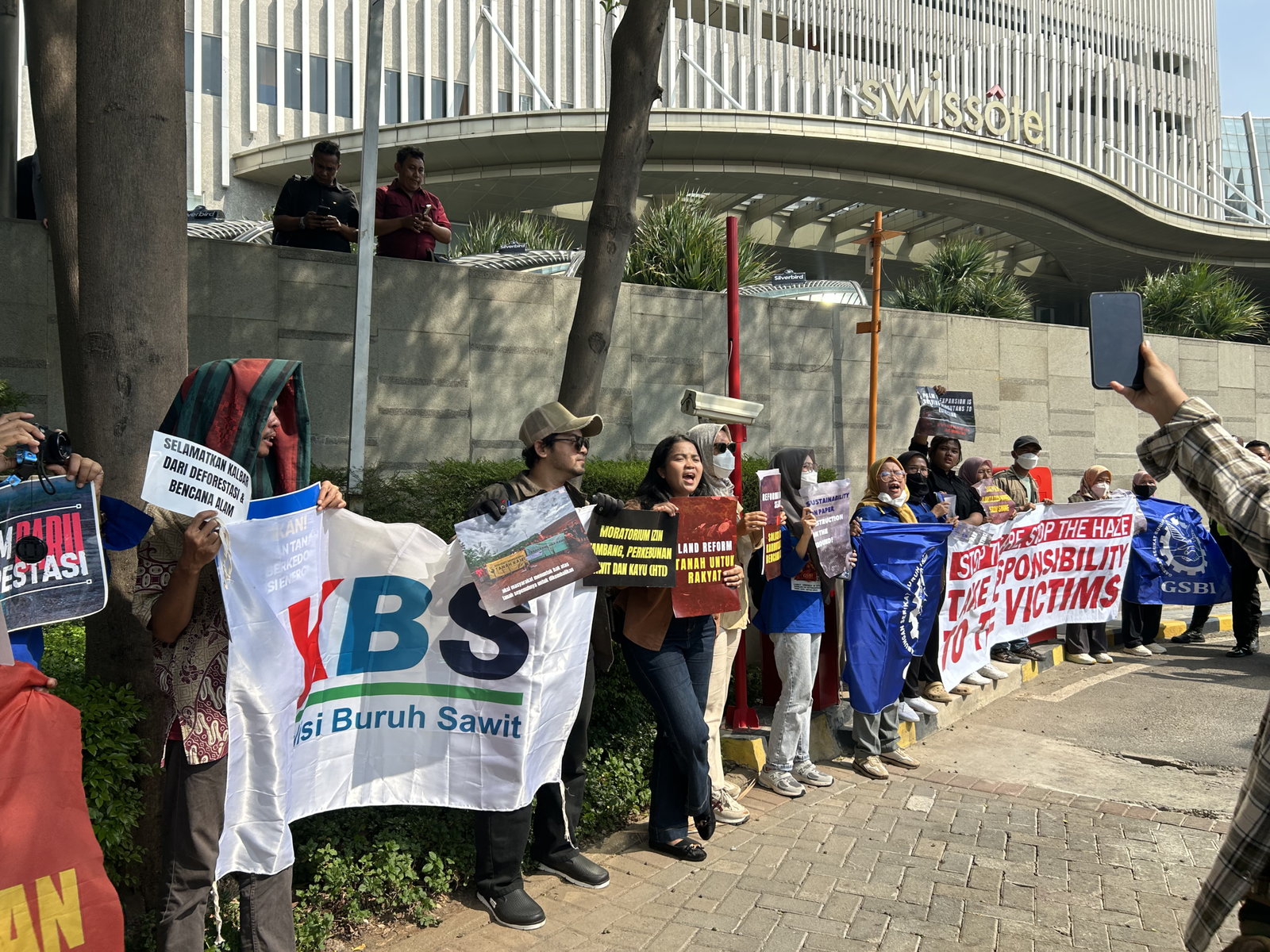
Protest Outside RSPO Meeting Venue Met with Repressive Actions; Coalition Demands Accountability from Palm Oil Companies for the Forest and Land Fire Crisis
JAKARTA, 4 November 2026 – A coalition of civil society organisations staged a protest outside the Roundtable on Sustainable Palm Oil (RSPO) meeting venue at Swissôtel Jakarta PIK Avenue, Indonesia, demanding accountability from palm oil companies for the ongoing forest and land fire (karhutla) crisis.
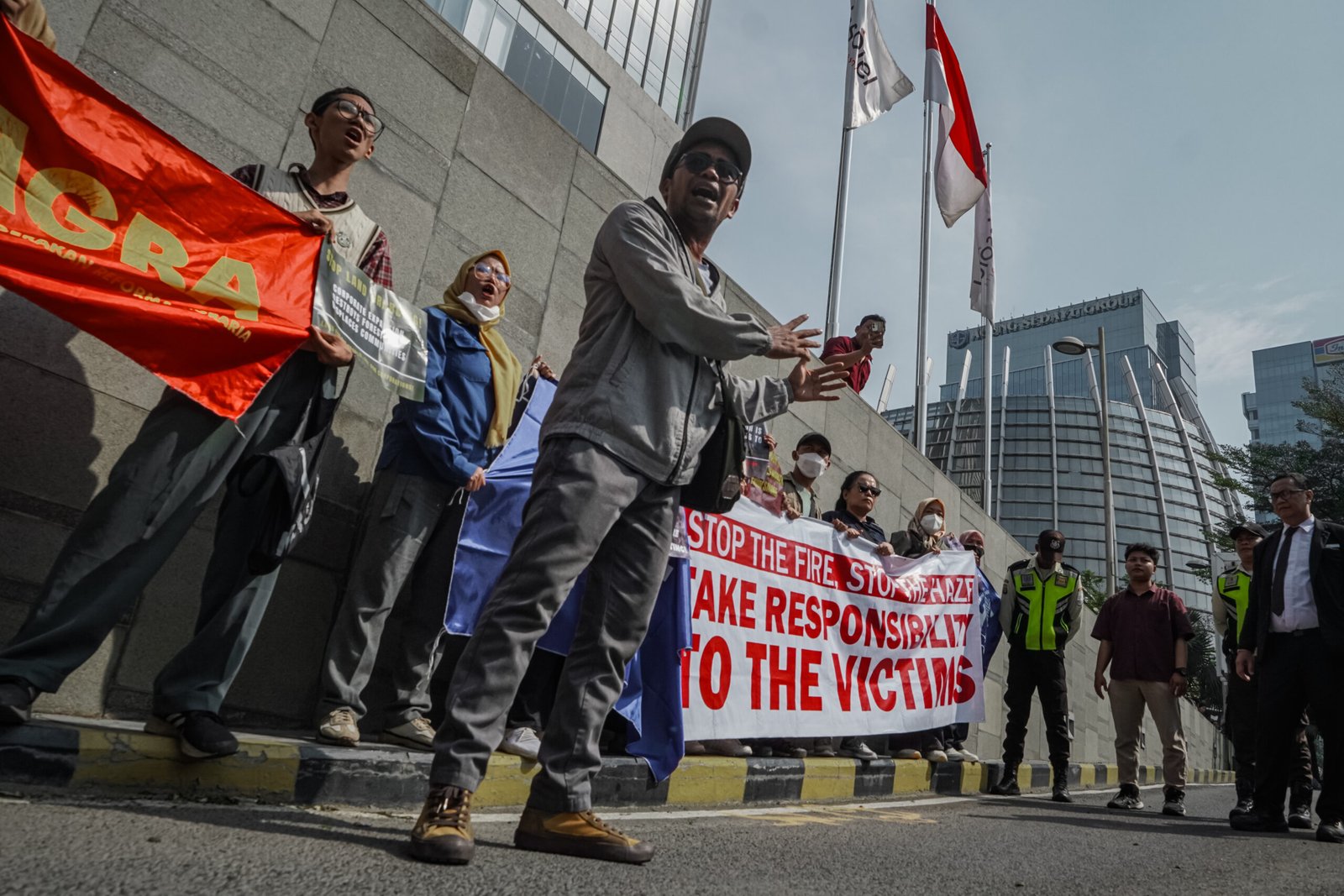
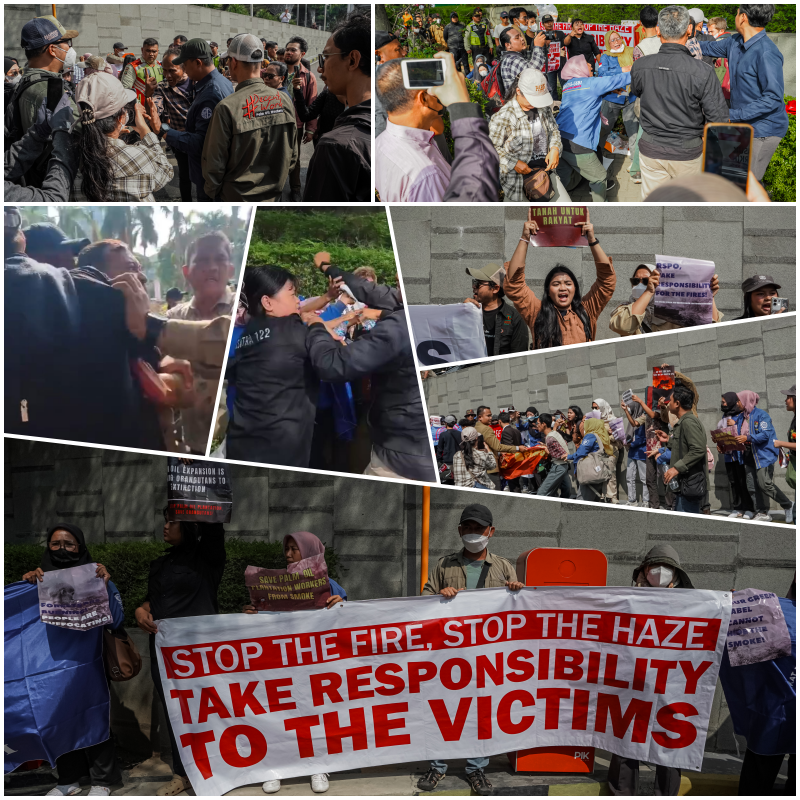
Around 30 protesters repeatedly chanted “Stop the Fires, Stop the Haze” while holding various banners and posters bearing their demands. Less than 15 minutes after the protest began, dozens of security personnel arrived and demanded that the action be stopped.
RSPO was established to promote the growth, development, and use of sustainable palm oil products through the implementation of global standards. However, far from fulfilling this objective, oil palm plantations owned by RSPO members have also expanded across peatland ecosystems. Peatlands dried out as a result of ecosystem conversion have exacerbated the forest and land fire crisis over the past three months. Satya Bumi recorded at least 1,505.85 hectares of land affected by fires within peatland ecosystems. Furthermore, out of the total 3,753.63 hectares affected by fires, 78.87 hectares were located within orangutan habitats.
“Forest and land fires have also affected areas of significant ecological value, including peatland ecosystems and orangutan habitats. This must be treated as a serious issue because there can be no sustainable palm oil produced on burned land or through the destruction of protected wildlife habitats,” said Riezcy Cecilia Dewi, Campaigner at Satya Bumi.
Meanwhile, AGRA Secretary-General Saiful Wathoni stated:
“RSPO, as an organisation that brings together oil palm plantation companies, must also take responsibility for the forest and land fires that have occurred. It must genuinely implement the principles of ‘No Burning, No Land Grabbing’ by imposing strict sanctions on its members. These sanctions must not be limited to administrative penalties, but must also include obligations to extinguish fires, stop the haze, and provide health, social, and economic compensation to everyone affected.”
“Forest and land burning has severely affected plantation workers. Not only are they still required to work, but they are also not given reduced workloads or production targets, let alone adequate respiratory masks. Healthcare facilities on plantations are extremely poor. The thousands of reported acute respiratory infection (ARI) cases only cover victims in urban areas. Conditions on plantations remain largely unreported. We suspect that the number of people affected by fire-related haze could be two to three times higher than the official figures,” explained Rizal Assalam, Coordinator of the TPOLS Network.
RSPO representatives eventually approached the protesters and invited several representatives to engage in dialogue. During the meeting, the civil society coalition presented its data and demands.
“Behind the slogan of sustainable palm oil, the reality is that the aggressive expansion of plantations and the palm oil industry has triggered land grabbing and recurring, prolonged social conflicts. Peasants, Indigenous Peoples, and the poorest segments of rural communities have been forced to lose their land and living spaces, while consistently bearing the economic, social, and environmental costs,” said Ahmad Syukri, Executive Director of Link-AR Borneo.
RSPO promised to provide a response, consider the protesters’ demands, and discuss them within the ongoing RSPO forum taking place on 3–4 November 2026.
During the protest, the civil society coalition put forward the following demands:
1. RSPO must reaffirm and implement its Principles and Criteria for Sustainable Palm Oil, particularly those concerning Respect for Human Rights and Communities, Protection of Workers’ Rights and Working Conditions, and Responsible Management of the Environment and Ecosystems.
2. The coalition urges the Government of President Prabowo Subianto to review all permits in the plantation and palm oil industry sectors, including halting the issuance of new permits. The government must reassess and revoke business licences and impose sanctions on companies proven to have engaged in forest and land burning and to be responsible for large-scale forest and land fire and haze disasters.
3. All large-scale plantation and palm oil companies must assume the highest level of responsibility for addressing forest and land fires and the resulting haze disasters, and provide affected communities with fair compensation for social and economic losses, as well as violations of their right to a healthy environment.
4. The coalition demands the unconditional release of all poor farmers, Indigenous Peoples, and other community members who have been arrested, detained, or imprisoned on allegations of land burning.
5. ASEAN, as an organisation bringing together countries in Southeast Asia, must strengthen its commitment to establishing regulations and legislation that recognise the right to a clean, healthy, and sustainable environment within a human rights framework, in accordance with international regulatory principles and standards.
Aliansi Gerakan Reforma Agraria (AGRA)
Lingkaran Advokasi dan Riset Borneo (Link-AR Borneo)
Satya Bumi
Rasama Hijau Indonesia (RHI)
Transnational Palm Oil Labour Solidarity (TPOLS)
Gabungan Serikat Buruh Indonesia (GSBI)
Koalisi Buruh Sawit Indonesia (KBS Indonesia)
Sentral Perjuangan Pemuda
